
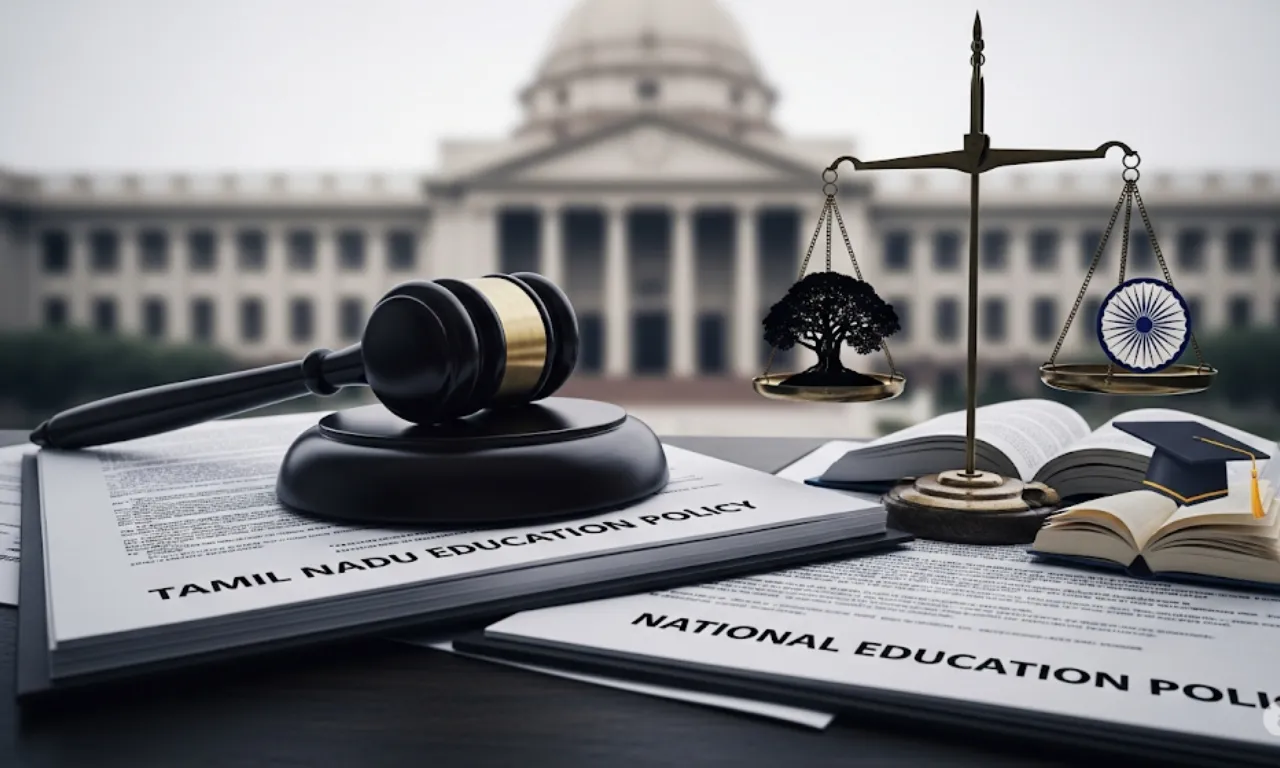
- Tamil Nadu introduces a new education policy keeping the two-language system, rejecting NEP 2020 and PM SHRI Schools Scheme.
- State files Supreme Court plea asking for over Rs 2,200 crore from Centre, challenging enforcement of NEP and related funding.
- Dispute affects students, educators, and policymakers, raising questions about the future of education and funding in Tamil Nadu.
New Education Policy Amid Dispute With Central Government in Tamil Nadu has caused a lot of discussion and legal action. The state government, led by Chief Minister MK Stalin, has started its own education policy focusing on a two-language system and higher education goals, while opposing the National Education Policy (NEP) 2020 and related central schemes like the PM SHRI Schools Scheme. This article looks at the main points of Tamil Nadu’s policy, why it opposes central initiatives, and the ongoing legal fight over funding and policy enforcement.
Tamil Nadu’s New Education Policy: Main Points and Goals
Tamil Nadu’s education policy focuses on keeping the two-language system in schools, prioritizing Tamil and English. This is different from the NEP 2020’s three-language formula, which the state government opposes. The policy aims to strengthen Tamil Nadu’s cultural identity while making sure students are well-prepared for higher education.
Chief Minister MK Stalin pointed out the success of government school students, noting that 901 students got admission to top institutions like IITs and NITs. With 75% of Class XII students enrolling in higher education this year, the government wants to raise this to 100%, showing a strong commitment to improving education.
Also Read – Nalam Kaakkum Stalin Scheme to Enhance Healthcare Access in Tamil Nadu
Opposition to NEP 2020 and PM SHRI Schools Scheme
Tamil Nadu’s rejection of the NEP 2020 comes from concerns about the three-language formula, which the state sees as forcing Hindi and a threat to social justice. The DMK-led government says the NEP weakens the state’s language and cultural independence.
Also, the PM SHRI Schools Scheme, which requires full implementation of NEP 2020, has faced resistance. Tamil Nadu refuses to adopt this scheme, pointing to the Memorandum of Understanding (MoU) that requires following NEP 2020 as a condition for funding.
Legal Fight Over Central Funding and Policy Enforcement
In May 2025, Tamil Nadu went to the Supreme Court asking for a declaration that the NEP 2020 and PM SHRI Schools Scheme can’t be enforced without the state’s agreement. The petition challenges linking central funds under the Samagra Shiksha Scheme to these policies, calling it “illegal” and “unfair.”
The state asks for the release of Rs 2,291.30 crore from the Centre, along with 6% yearly interest on Rs 2,151.59 crore from May 1 until full payment. Tamil Nadu also requests timely release of grants-in-aid as per the Right of Children to Free and Compulsory Education Act, 2009.
Effects on Students, Educators, and Policymakers
This ongoing dispute affects many people in Tamil Nadu’s education sector. Students may face uncertainty about curriculum and language teaching, while educators have to deal with conflicting policies. Policymakers face the challenge of balancing state independence with central rules, affecting the future of schooling in the state.
As the legal case continues, the outcome will be key in deciding how education policies change in Tamil Nadu and how central funding is handled. For now, the state’s firm position shows the importance of respecting regional identities within national systems.